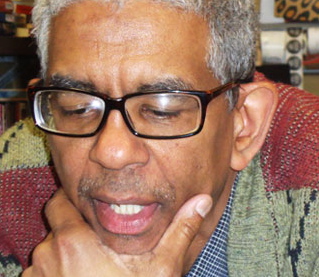
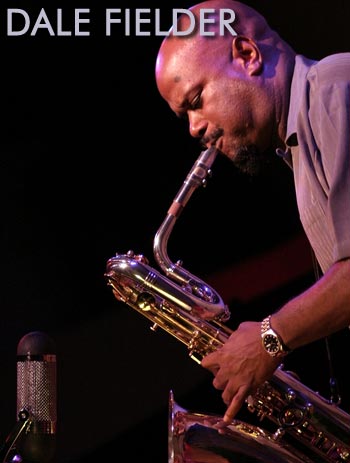
"Bought a bag of Howling Monk beans just to support the brother..Much to my surprise I sampled some of the best coffee I have ever tasted!! Kinda saying a lot since I worked for American Airlines for over 20yrs and have had coffee everywhere from the Peoples Republic of Armenia to Havana, Cuba."
To comment, question, or suggest: Email howlingmonk@earthlink.net
“We have to create an art for liberation and for life.”
(Elizabeth Catlett 1919-2012)
Many people love and appreciate Jazz music.
Many proclaim it to be America's most significant contribution to art.
They are right! And Jazz is even more.
In ancient times the word "Jazz" was not known,
but there was knowledge of the art's spiritual essence:
rhythmic consciousness.
In that consciousness there was and still is
a state of mind where creative energy
can be cultivated for use in life.
Jazz is a way of thinking, a way of doing things, a way of being;
Jazz is a way of cultivating creative energy.
It is an art for liberation and for life.
Welcome!
Working Notes:
America
Until we are no longer enchanted by the idea that God smiled on our nation’s founding fathers as they declared independence and proclaimed freedom for “white” people such as themselves while promoting the enslavement of “black” people and tolerating their denigration, and while stealing the land of the indigenous people through a system of genocide, none of us who call ourselves Americans have much of a future.
And so, our Jazz State of Mind exists.
Creative Birthright
In the context of what follows, art is defined as the use of creative skill, imagination, and emotion to express individual views. Religion is defined not necessarily as belief in a god or group of gods, but rather as an activity involving ceremony and rules that are very important to a community of people.
All works of art: music, literature, and paintings, etc. and all religions have, at their core, a spiritual element because both art and religion are born of an individual creative instinct that has been further developed, made meaningful, or sustained in some manner by a community or culture.
The creative instinct is present to some extent in everyone because the creative instinct is the spiritual part of human nature that raises and expands curiosity in the individual about life and its rhythms and patterns and its other manifestations. When consciousness rises, a veil that seems to encompass the universe parts and it is possible for the individual to gain a greater understanding of collective existence.In the grandeur of the revelation, the individual is often driven to express whatever they can of it, and thus, art and religion is born.
Revelation. however, is often momentary to the individual who witnesses because consciousness is part of the universal order and, therefore, must fall as it rises and follow its path back to its origin and so on.
Born of the natural creative instinct, the experience of higher consciousness and revelation is the birthright of everyone, but ironically, it is the apparent unique talent of great artists or the apparent divine inspiration of prophets and the idolization of their apparent gifts that diminishes and, sometimes, dissolves all together, the creative birthright of everyone.
The Complexion of Mind
Complexion of the skin does not determine character.
What Dr. Martin Luther King Jr, called the content of character is the complexion of one's mind; it's cultivation and expression.
Character is determined by the texture of one's relationship with one's self and with others; the way one thinks, what one says, and what one does.
The content of character is the complexion of mind.
The Open Mind
Those That Are Not
If, what comes to mind meets and melds with what rises from the heart, then there may be real value to that which rolls off the tongue. Our words are more meaningful, and so too are the things we do, when they are guided by innocence of mind and buoyancy of heart than those that are not.
The creative process is a series of movements.
The initial movement is spiritual. It is the movement of an idea from its mysterious source into the mind of the artist. The artist strives to keep the mind as open as possible because ideas must flow freely in order to arouse the imagination..
Creative people look forward to the arousal of their imaginations because imagination is potential and possibility; things that motivates their work.Their work is to transform spiritual things into things of substance such as music, drawings, paintings, writings and so forth.
Artists are satisfied when their imaginations are fulfilled.
The creative process is powered by the creative energy that is inherent to thoughts and ideas. That energy is powerful and transformative.
Ideas
There are many precious things in life. A precious thing for creative person is an idea that does not vanish until its mysterious qualities have stirred the imagination.
The creative process moves within the fragile framework of the imagination. Artists use their creative skills to expand on their thoughts about the ideas that stir their imaginations. In success, they are, like their imaginations, satisfied.
Godliness
The elements of art are mysterious. They are mysterious because ideas, imagination, and the mind and its its ability to release and conduct powerful creative energy is essentially spiritual.
We often think of rhythm and harmony as musical elements without considering their spiritual qualities. Rhythm and harmony and many other elements of music are natural phenomena. Rhythm determines the intensity its flow just as it determines the various movements of nature. Harmony controls and composes that flow bringing otherwise random movements into concord with a greater whole.
The word or term “neter” generally refers to the mysterious gods of ancient Kemet (Egypt). However, the idea of many gods is not so mysterious when we understand that the essence of a neter is its power to awaken the many aspects of the mind release their creative energies back to their original source. Referring to the neters, one Egyptologist said, “The ancient Khemitians (Egyptians) taught that All was going and returning...movement seeking to return to the source, kinetic energy seeking to become all potential energy, at rest, in harmony, homeostasis, in balance, in equilibrium!”
Over the course of thousands of years, our ancestors observed the natural phenomena of the creative energy in their presence and often personified it realizing that creative energy was present in their minds. In so doing, they did not offend the gods, but rather honored the gods by cultivating the sense of their own spirituality and godliness.
Mysterious Instance
An idea comes to mind, and when the mind is that of an artist and, when the idea has sufficient inspirational quality, it may cause the artist to think about it and act. Action transforms ideas into more substantial things. And, sometimes, when the act is that of an artist, the idea is transformed into something significant.
The coming to mind of an inspiring idea is the somewhat mysterious instance that Pablo Picasso called the “point of departure.” It is what artists need. So they hope for it and wait for it because the mysterious instance stirs the imagination and motivates the creative process.
The mysterious instance occurs and the artist follows the circular stairwell of the creative process higher and higher and deeper and deeper into the realm of creation where the artist works in patient urgency. The work engenders more and more ideas and the mind opens wider and wider until there is a definite sense of understanding and resolution concerning the resulting creative matter.
And when that sense of understanding and resolution is present, there is also a sense of satisfaction accomplishment because the artist sees spiritual opportunities and feels powerful its midst. Romare Bearden may have described it best when he said the visual artist is “a kind of enchanter in time” who puts down one color and it calls for an answer.” It is a spiritual communication between the artist and the work that helps the ideas fulfill their potential and eventually their flow. The spiritual communication peaks and the stairwell to steepens and vanishes bringing the creative process to its end. Then, the artist's mind seems empty and, for the moment, the artist rests.
Wassily Kandinsky said a true work of art is “a mysterious, enigmatic, and mystical creation that detaches itself from the artist” and it does. Kandinsky explained that the work of art “acquires an autonomous life, becomes a personality, an independent subject, animated with a spiritual breath, the living subject of a real existence of being.”
Having fulfilled itself, the inspiration idea doen't die. It returns to its mystical source unchanged. The work of art remains standing as a testament to the power of mysterious instances.
The Mind's Eye
A writer on the subject of the mind said that there has been “a lengthy tradition of inquiries in philosophy, religion, psychology and cognitive science (that) has sought to develop an understanding of what a mind is and what its distinguishing properties are.”
So what is the mind? What are its distinguishing properties?
In his book, T’AI CHI CLASSICS, Waysun Liao said the mind is part of the human being, but it is the only part of the human being that does not belong totally to the earth. Unlike the human body which is made up of earth and is satisfied by earthly things such as food and shelter, the mind is satisfied by a demand for activity and a need to expand.
So it seems that other than its apparent need to have, at least, temporary residence in the human body, the mind is a transitory province of the human body because of its demands and needs are more spiritual in nature than they are physical in nature.
The mind’s demand for activity and its need to expand are both stimulated by ideas that enter the mind by way of “the mind’s eye.” The human body has no way to stop the entry of ideas into the mind because the entry is spiritual and the human body has no way to short-circuit the transformation of these ideas into the creative energy that activates the expansion.
The flow of creative energy opens the mind and raises spiritual consciousness of physical things giving some people a powerful sense of their inherent freedom to think and imagine and explore without constraint.
Abnormality
The freedom to die was the only freedom America's enslaved people had.
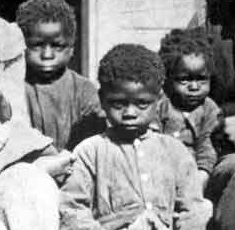
Life was a nightmareset in the shadows of their captor’s abnormalities. And from deep in the blackfulness of those shadows, millions of slaves waited for life to end and in their waiting and wanting to die, they were, sadly, abnormal too.
War or Self-Inflicted Turmoil
Some scholars define war as a universal and ancestral aspect of human nature suggesting that war may be an unavoidable event in our attempts to resolve our differences, but in his book, LIGHT FROM ANCIENT AFRICA, Dr. Na’im Akbar suggests that when “the eye that transcends the senses” is open, our differences are merely "superficial."
Transcending the senses is a matter of opening the closed mind. The closed mind only sees outwardly and focuses on exterior differences such as differences in skin tone, and eye color, and hair color, etc. Opening the mind allows us to see what Dr. Akbar calls, “the essence of sameness” in people and things.
The open mind sees the outward differences, but it also sees inwardly. The open mind sees that there is an inter-relationship between people and things that is essential for the balance of individual life and community life.
The idea of an essential balance for life is contained in the ancient spiritual principal of Maat or the voice within, conscience, what the Ancestors called “an eternal spiritual guide” that warns us whenever we go astray. In seeing our outward differences and looking inward to find the sameness in the difference, we maintain the balance and can avoid the conflicts that often lead to self-inflicted turmoil
and war.
An Art for Liberation and Life
In her book, THE MUSIC OF BLACK AMERICANS, Eileen Southern wrote about Jazz. Of its birth, she said: "Some historians trace its origin back to about 1912, when the press began referring to the white dance bands that flourished in the larger cities as 'Jazz Bands.'"
Most of the early 20th century Jazz Bands were popular because their music helped entertain the American masses. In the immediate aftermath of slavery, many Americans wanted to move on and forget those cruel chapters of their nation’s history. The early Jazz Bands helped.
Of the word “Jazz” itself, one researcher says it first appeared in the lyrics of a song in 1909.In the book, THE CREATION OF JAZZ, Burton Peretti said, “The white publicists and critics who first defined Jazz for the mass public, rarely praised the music as an art form, and in fact they usually ignored the central role of Blacks in its creation.” Southern observes that the word “Jazz” was probably in oral circulation for some time before anyone had a need to see it in print.
In any case, the word “Jazz” was new to most early 20thcentury Americans. Since then, much research has been done to trace not just the word “Jazz” to its roots, but to trace the root to its spiritual essence.
No definition of the word "Jazz" is complete without acknowledging the word’s likely African origin because many researchers have found that the word "Jazz" was derived from the Mande word “Jasi.”
According to Dr. Joseph Holloway, “at least 60 percent of the ancestors of Americans of African descent came from the Mande (West African) and Bantu (Central African) ethnic and linguistic groups.” He says that the Mande civilization began with ancient Ghana and developed between C.E. 200 and 1200 in the region between the bend of the Niger River and the middle reaches of the Senegal River.
Holloway’s historical information supports a footnote in Dizzy Gillespie's book, TO BE OR NOT TO BOP suggesting that Jasi may be the root of Jazz. Jasi however, is less a musical term than it is a term used to describe something abnormal or to describe people who have been diminished or people who act out of the ordinary. Indeed, there have been many witnesses to such behavior.
No definition of the word "Jazz" is complete when it overlooks or attempts to diminish the art form’s fundamental spiritual/creative essence: the connection to an ancient art of stirring the mind's reservoir of creative energy in order to raise rhythmic and spiritual consciousness. Indeed, Jasi also means to speed up and to excite.
It is a fact that, among the African people held in slavery in America, many great and forever un-named mystics worked in secrecy cultivating the creative energy they used to revive and raise the spiritual consciousness of their fellow captives. They had no time or use for entertainment.
It is also a fact that most forms of “Black” art known today have both American and African roots. However, Duke Ellington, the great maestro, knew very well that there was an inexplicable, mysterious quality in music of his people.
Ellington said:
"The music of my race is something more than the American idiom. It is the result of our transplantation to American soil and was our reaction in plantation days to the life we lived. What we could not say openly we expressed in our music.”
The First “Black” Church?
Many "Black" people fought for their freedom. Many lost their lives. Some lost their minds because the nightmare they lived was beyond expression. They couldn’t understand its meaning. All they knew was that they were to be forever separated from everything and everyone they had ever known. They lost their minds and were alone.
An ancient state of mind died and came back to life late in the 15th century. It was the time in history when many of Africa’s most peaceful and creative children were uprooted from their ancestral homelands and forced into perpetual slavery in a "New World" where the slave's captors called themselves "White" and had strange dreams.
Their captives were called "Black" and they were sentenced to life in a nightmare.
While trapped in the nightmare, a few found a higher sense of their spiritual selves. In time, these mystics revived the art of cultivating creative energy in the mind. They used that ancient art to decipher the nightmare.
The mystics taught the art to others. The art, however, did not free anyone or return anyone to the lands and traditions of their ancestors in a physical sense. The nightmare was too real. But, they were able to raise the sense of the spiritual see how the nightmare unfolded before it unfolded and the nightmare's impact on had no impact on their sense of soul.
The more these mystics and their initiates worked, the more an ancient state of mind was affirmed. It cultivated in the underground of slavery's institutions with great care over many generations. An ancient un-named state of mind was a vital safe haven at the abyss of a long nightmare.
It was the first “Black” church?
Spiritual Music
The music made by the early Jazz dance bands was designed to bypass the listener’s mind as much as possible. Its primary purpose was to entertain people and help them pass time away as dispassionately as possible. Enertainment was necessary in America, the land of the free and home of the brave. Many Americans knew the truth of the nation's recent nightmare and as they dreamed, they also feared that it would awaken them to reality.
As entertainment became more and more popular, some “Black” musicians developed another, more meaningful, spiritual vein of Jazz music.
"After emancipation," Sidney Bechet said, "all those people who had been slaves, they needed the music more than ever now; it was like they were trying to find out in this music what they were supposed to do with this freedom: playing the music and listening to it - waiting for it to express what they need to learn once they had learned it wasn't just white people the music had to reach to, nor even to their own people, but straight out to life, and to what a man does with his life when it is finally his."
“This is serious music,” Dizzy Gillespie said.
This music uses creative energy to raise the rhythmic consciousness of listeners and bring forth a state of mind that employs the imagination of listeners to an extent that they become active participants in an ancient form of spiritual expression.
Jazz Scholars & Historians
Some people don't understand that all true "Black" art is serious. They don't see "Black" art as spiritual, perhaps, because they don't know that "Black" art springs only from an ancient reservoir of creative energy and not from its modern influences.
Some so-called Jazz experts say they can't see how Jazz is a "Black" form of art because, in their minds, there has been no "Black" experience or "Black" culture that does not have "White" or European roots. They ask: “Is there anything specific in the “Black” experience or culture that has produced anything significant in the way Jazz music is played?’ One such scholar takes the matter to an extreme. He discounts any description of Jazz that has any connection to anything mystical. The only connection acceptable to that so-called scholar is one that begins and ends in the field of American pop entertainment or who to one connected to America's plantations in the antebellum South and the pitiful sound of slaves moaning and groaning - the so-called field hollers.
These so-called Jazz scholars and historians, etc. will never admit that jazz expresses what W.C. Handy called "the bleak realities of poverty and racism" and a yearning for love.
The Mind and Collective Memory
The mystics of the First "Black" Church understood that the source of creative energy is outside of the individual physical body. They understood that creative energy flowed into the individual mind. They understood that, in the mind of the individual, creative energy could raised and that, when raised, it could move the individual from one state of mind to another and back to its source.
Dr. Alain Locke, the man known as the “Father of the Harlem Renaissance,” claimed that “all classes of people under social pressure are permeated with a common experience; they are emotionally welded as others cannot be. With them, even ordinary living has epic depth and lyric intensity, and this, their material handicap, is their spiritual advantage."
Ira Gershwin, the famous Jewish American composer, made a similar and equally mysterious claim. “Deep unspeakable suffering,” he said, “may well be called a baptism, a regeneration, the initiation into a new state.”
The mystics of the First "Black" Church learned of the communion of body and soul and the dance with spirit that takes place on the spiritual common ground engendered by the dance itself. They found that like-minded individuals - all who had been moved by their creative energy to the dance ground - eventually embraced a common sense of their feelings. They discovered that a bridge exists bridge between the body and the soul. They discovered that nature is revolutionary; that birth, life and death proved its truth.
In his book, The African Origin of Biological Psychiatry, Dr. Richard King referred to “the hidden doorway to the collective unconscious...darkness, the shadow, the primeval ocean…the accumulated experience and wisdom of the ancestors."
Millions of initiates were taken to these places. There, they were awakened to the wisdom of the ancestors and their collective consciousness. They returned to bring others because it was their duty.
In his book, THE HEALING WISDOM OF AFRICA, Malidoma Some’ said, “Indigenous people know that there is collective memory and there is individual memory. Collective memory is not a vast well that exists separate from individual people. It is the sum total of the personal memories of each person. In other words, for a village, a tribe, and a culture to remember, each individual must master the ability to remember the knowledge that lives in his or her bones.”
The universe does indeed have a collective memory that is like the grand library everything that has ever occurred. It never closes. It contains every iota of the wisdom attained by the ancestors. Some people may not believe that a mystical entity of this kind exists, but there are others who attest that it exists and extends as far back as 300,000 years. They say that such as entity is accessible to anyone who can overcome the limitations of their negativities; cross the bridge between the idea of unbridgible differences; between the real and the imagined; the seen and the unseen and so forth. Everything is equally valid in the whole depending on one's perception of them.
To traverse the bridge to the collective memory negates nothing and validates everything. Moving the mind to that space brings life and death into harmony because as one’s mind moves, one’s spirituality moves as well and in the movement the scope of the natural connectedness of everything in the universe widens and there is a peace of mind that is otherwise absent.
"Black" Music?
"Music is everything,” the maestro, Duke Ellington, observed. “Nature is music…cicadas in the tropical night...the sea is music...the wind is music...the rain drumming on the roof and the storm raging in the sky are music. Music is the oldest entity. The scope of music is immense and infinite.”
A Stagnant Mind
A stagnant mind weakens and endangers the entire community An inactive mind does not contribute to the community's collective memory because it does not move and therefore cannot connect with its collective memory. A stagnant mind does not recall the wisdom of the ancestors because it wanders with no clear purpose. It is not good for people to wander about without purpose. They can do harm to themselves as well as to others.
"Black" Mystic
When people realize that their similarities are of greater value to them than their differences and when they cultivate their similarities for long periods of time, they grow spiritually. And when they have grown spiritually, they realize that everything between life and death is mystical.
The essence of a spiritual experience is its ritual element and it is a welding that takes place in the fire of individual imagination of the activities, signs, symbols, systems, etc. that support, and formalize the values and ideas of others who need them and use them. A real measure of community forms from this welding.
Malidoma Some' describes ritual further as "the most ancient way of binding a community together in a close relationship with Spirit.” “Ritual,” he says, “has always been the way of life of the spiritual person because it is a tool to maintain the delicate balance between body and soul."
The majority of Africans enslaved in America were of West African ancestry. Many of their ancient rituals stayed alive in their collective memories. The idea of community was not theoretical to them. Community was a reality; a tradition, the foundation of culture. The rituals necessary to sustain these things and other things were alive in a collective memories of the Africans who were uprooted and taken to foreign lands to be enslaved.
The ritual activities of these people were summarily dismissed and often forbidden by their captors. So too were the African Mytics who came into captivity with their people. In Africa they had attained knowledge and insight into ancient mysteries that transcended the knowledge and insight of the captors. The African Mytics became "Black" Mystics in the epic cultural of the early 17th century. The "Black" Mystics adapted everything; the essential knowledge of the rituals, the insights into their meaning, their spiritual value and the art of cultivating them.
No taboo levied from outside of the sphere of influence of the "Black" Mystics was ever powerful enough to nullify or invalidate anything they ever did. From ancient times, everything of their work and in their work had been welded in the fire of individual imagination to enable the mind to rise and move and connect to collective memory.
Sho Bad Times
In the aftermath of the long nightmare, an elderly “Black” woman – a former slave - looked back:
“Lawd have mercy...Lawd, Lawd, dat sho bad times. Black folks jes’ raise up like cattle in de stable…Don’t know nothin’ ‘bout myself. He (the man who held her captive) says I’s a South Carolina n----r what he bought back der and brung to Texas when I jes’ a baby. I reckon it de truth ‘cause I ain’t never knowed no mama or papa, neither one.”
Dr. Claud Anderson said in his book, BLACK LABOR, WHITE WEALTH, Labor, that 20 to 35 million “Blacks" were killed outright and another 15 million were physically enslaved, psychologically abused, academically impaired, and economically impoverished for 400 years. In America he said the practice of enslaving African people was economic and unusual in every sense. He called it the peculiar institution.
The once-enslaved, Frederick Douglass said: “I have no accurate knowledge of my age, never having seen any authentic record containing it. By far the larger part of the slaves know as little of their ages as horses know of theirs, and it is the wish of most masters within my knowledge to keep their slaves thus ignorant. I do not remember to have ever met a slave who could tell of his or her birthday. A want of information concerning my own was a source of unhappiness to me even during childhood...I was not allowed to make any inquiries of my master concerning it. He deemed all such inquiries on the part of a slave as improper and impertinent, and evidence of a restless spirit."
Lawd, dat sho bad times.
Steal Away
Dr. Claude Anderson said that the moral questions of slavery and race were “either ignored or justified by the use of Biblical references that were included in the King James version of the Bible that was written after England officially approved Black slave trading in 1618.”
In TO BE OR NOT TO BOP, Dizzy Gillespie said the so-called slave masters "wanted the Africans to accept Jesus Christ as the Son of God. Accept that, but don't practice it with the slave masters; because by the whole system of communications which the Europeans set up, the Africans were lesser, and how could you talk about brotherhood of man and hold these people in that condition of slavery?"
Gillespie continued: "During slavery the masters didn't want any two people on the plantation speaking the same African language. If they found out two people were from the same tribe, they'd sell off one because they wanted them to speak English so the slave masters would know what they were talking about all the time. They couldn't have any secrets and they didn't want Africans to practice their own religions."
A man born into slavery in the years leading up to the Civil War recalled that slave on the plantation was taught to read or write. Yet, on Sundays many slaves were gathered under the watch of the overseer and although no one present could read the Bible, they had church service. The preacher was another slave who was trusted by the slave owner because he was sometimes allowed to attend the slave owner’s “White” church. The “Black” preacher preached because he was “better informed.”
But these services only made many slaves anxious to steal away from the plantation for their own secret spiritual activities.
“When de n---ers go round singin’ ‘Steal Away to Jesus,’ dat mean dere gwine be a ’ligious meetin’ dat night. De masters … didn’t like dem ’ligious meetin’s so us natcherly slips off at night, down in de bottoms or somewhere. Sometimes us sing and pray all night.”
An Internet article asserts:
“During slavery in the United States there were systematic efforts to de-Africanize the captive Black workforce. Slaves were forbidden from speaking their native languages, and were generally converted to Christianity. Because they were unable to express themselves freely in ways that were spiritually meaningful to them, enslaved Africans often held secret religious services. During these ‘bush meetings,’ worshipers were free to engage in African religious rituals such as spiritual possession, speaking in tongues and shuffling in counterclockwise ring shouts to communal shouts and chants.”
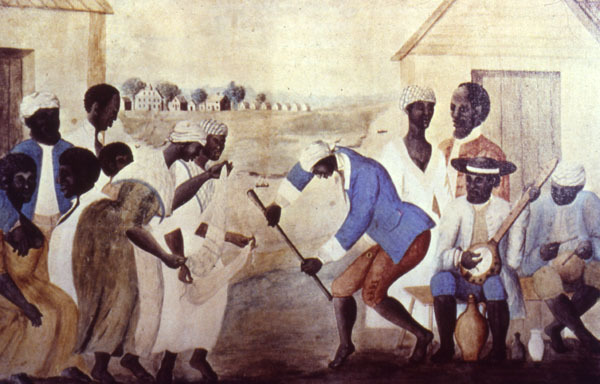
Over many thousands of nights, deep in the darkest of nights, enslaved Africans stole away from their so-called masters and their overseers and their designated “Black” preachers. They secreted away to resurrect their own spiritual traditions.
“Those who have not witnessed the frenzy of a Negro revival in the untouched backwoods of the South can but dimly realize the religious feeling of the slave.” So wrote W.E.B. DuBois in his 1903 masterpiece, THE SOULS OF BLACK FOLK.
The resurrections were too intense for the shrinking capacity of minds stagnating in the nightmare of their predicament. So, they stayed behind and were never re-initiated into the ancient spiritual traditions. Some simply had lost their minds and had fallen in love with their masters. Yes. Some had become so estranged from themselves that the idea of being free of their masters frightened them. Others, the - initiated -moved regularly and silently and courageously into the forests and other places to hold their secret resurrections: resurrections that sometimes ignited the spirit of insurrection. These Africans enslaved in America laid the cornerstone of what some historians call “the invisible institution” what survived to become the “Black” church.
In his 1903 book, DuBois described the enslaved African as “a religious animal – a being of that deep emotional nature which turns instinctively toward the supernatural.” The men, women and children brought to America were “endowed with a rich tropical imagination and a keen, delicate appreciation of Nature.” DuBois said that these people “lived in world animate with gods and devils, elves and witches, full of strange influences, -of Good to be implored, of Evil to be propitiated.” Slavery was to the African “a dark triumph of Evil over him. All the hateful powers of the Under-world were striving against him, and a spirit of revolt and revenge filled his heart.”
An epic ongoing struggle to save body and soul was at the heart of the secret African religion in America. It was complicated, deeply spiritual and quite mystical.
Many things must be understood to properly characterize African spirituality as it was adapted to the enslavement of African people in America.
DuBois described three:
One was the intriguer, the idealist, the Preacher: “the most unique personality developed by the Negro on American soil.” The second thing was the Music with its “plaintive rhythmic melody” and its “touching minor cadence, which despite caricature and defilement, still remains the most original and beautiful expression of human life and longing yet born on American soil.” Africa was its root, but he observed that it had been “adapted, changed, and intensified by the tragic soul-life of the slave, until, under the stress of law and whip, it became the one true expression of a people’s sorrow, despair, and hope.” The third characteristic of the slave’s spiritual activities was what he called “the Frenzy of Shouting” which occurred when the Spirit of the Lord passed by and “by seizing the devotee, made him mad with supernatural joy…so firm a hold did it have on the Negro, that many generations firmly believed that without this visible manifestation of the God there could be no true communion with the invisible.”
Mystical? Yes. No degree of human rationality can totally enslave the mind because the mind can move. And when the mind moves it connects to a collective memory that is naturally free.
Rhythmic Consciousness
Creative energy is powerful. Many laws were enacted in America to kill the active power of enslaved Africans, to deaden their rhythmic and spiritual consciousness. These laws, however, were more effective in some places than in others.
In his book, THE RHYTHMS OF BLACK FOLK, Jon Michael Spencer said there was a conspiracy to suppress African humanity. A central part of that conspiracy was, in the words of Spencer, “to de-rhythmize” Africans enslaved in America. Spencer notes that the law-makers failed because they could not to stop their slaves from drumming, dancing, singing, preaching, praying, clapping, stomping, swaying. The taboo-makers had no way to keep infants from being cradled to bosoms to the rhythms of the beating heart. Had the slave owners succeeded, Spencer concludes that “after a generation or two the slave-owners would have succeeded in de-rhythmizing their captives”
According to Gillespie: “The slave masters took away the blacks’ prime means of expression (the drum) and wouldn’t let them play it, which was very smart of the slave masters because you could talk with the drums and foment revolution and uprisings. Everybody would know what was happening, so they (the slave masters) wouldn't let them play the drums."
It was certainly rare for enslaved Africans to play a drum in the presence of their so-called masters. The prohibition only led "Black" Mystics into the underground where their knowledge of drums was disseminated to their initiates. These Mystics had mastered the art of cultivating creative energy for use in raising rhythmic and spiritual consciousness. Initiates were taught how to raise their rhythmic and spiritual consciousness above ground, in the course of everyday activities. Their ancient ways of thinking spiritually and being rhythmic was revived. In the view of their so-called slave masters, they were evidence, not of a dangerous restless mind in their midst, but rather more evidence of the “happy-go-lucky N-g--rs” that existed in their minds.
In an essay titled, Black Art, Black Magic, Ron Milner explained that, of all the arts, music is the lest concrete. The inherent flexibility of music helped some "Black" musicians free themselves from the constraints of their circumstances during slavery times. Did they know what Léopold Sédar Senghor wrote of many decades later? "Music and rhythm find their way to the secret places of the soul. Music creates order out of chaos; for rhythm imposes unanimity upon the divergent, melody imposes continuity upon the disjointed, and harmony imposes compatibility upon the incongruous." How did those enslaved "Black" Mystics know?
Most of the men, women and children interned in the peculiar institution of slavery in the "New World" were uprooted from the vast region of West and Central West Africa. Vast as it was, a common thread of rhythmic and spiritual consciousness connected the people to one another.
Among the enslaved people there were "Black" Mystics who believed, as their ancestors believed, that the Spirit enters the individual mind by way of the ear. And so, the enslaved storytellers of Ghana, Melle (Mali), Songhay, and elsewhere used the calabash of the ear to keep the traditions of the people alive. And so, the enslaved Dogon people could not be kept from making and using drums because they believed, as their ancestors had believed, that the drum is the ear of God and that through it they could speak directly to God on behalf of mankind.
In the book, THE HEALING DRUM, Yaya Diallo and Mitchell Hall, observe that music can facilitate psychological therapy. They say: "Since psychologically disturbed individuals are rhythmically disturbed as well, the use of the healing drum for sustained periods of time at a steady rhythm that suits the patient is a potent remedy for body-mind healing. Through the ears, the entire nervous system is affected. Sound energy is transformed into bioelectric energy. As the brain waves and rhythms of internal organs are stabilized, the person functions as a more synchronous whole."
To be continued
There are many states of mind.
The physical body is a perishable container. It can be controlled and even enslaved by outside forces. Spirit, however, is an invisible, uncontainable entity that resides in the individual state of mind. One's mind, encompassed by the inherent power of spirit, is creative and able to move, and one may thereby transcend present states of being.
At times, one’s spirit may seem to reflect and react only to the physical manifestations of one's existence. But one's spirit naturally aspires to reflect and react to one's true self or soul. One's spirit is a property of the mind and both are universal in nature.
And so, expression passing through this mysterious realm often rejuvenates, re-creates, regenerates - rebirthing the self.
Jazz came, not out of a musical tradition, but rather "out of a communal experience” as Max Roach said. And that communal experience was never and is not now necessarily musical. Albert Murray called Jazz “the ancestral down-home voice at its highest level of refinement” and that voice is not unlike the experience. Together, they are the root of an ever-encompassing and long-lasting echo of "Black" reactions: a look, a glance, a gesture, a stance, a silence, a scream, and more; all reactions to a unique American experience.
True. Jazz music can be, and often is, the catalyst into the Jazz state of mind, but once there, the music often fades and deeper, more significant things take shape: emotions forming a surreality; an invisible collective mentality that necessarily fulfills the individual expression it inspires. Yes. Jazz is more than music.
Black Surreality
Jazz, as an approach to creative expression, provides the artist with unlimited points of departure. The artist is free explore the invisible mind where a certain surreality may be found. Artists often express revolutionary ideas that may, at times, so stir the higher spiritual self that those who experience their work are also awakened or re-awakened, as the case may be.
The Mind
An article written on the subject of the mind says: “A lengthy tradition of inquiries in philosophy, religion, psychology and cognitive science has sought to develop an understanding of what a mind is and what its distinguishing properties are.” Those inquiries are ongoing. However, in the book, T’ai Chi Classics, Waysun Liao offers a conclusion that the mind is the only part of the human being that does not belong totally to the earth. The working Jazz state of mind is a mental activity that enables those who can perceive its existence to gain consciousness of the earthly experience in a spiritual sense.
Ludwig van Coltrane
"All classes of people under social pressure are permeated with a common experience; they are emotionally welded as others cannot be. With them, even ordinary living has epic depth and lyric intensity, and this, their material handicap, is their spiritual advantage." ( Alain Locke, Dean of the Harlem Renaissance)
Social pressures develop at different times and in different places from very different circumstances and although the length, depth, and intensity, etc. may differ, there is the possibility that some things, when contemplated in their larger more universal contexts, may be perceived in much the same manner by people under similar pressures.
Indeed, German composer and pianist, Ludwig van Beethoven and African American composer and saxophonist, John Coltrane, lived at different times and under different degrees of social pressure, but their music, when contemplated its larger more universal context, expresses something of a common state of mind.
Of Beethoven’s experience, one writer says:
“Beethoven was from a poverty-stricken family, son of an alcoholic, and resented the social strata which excluded him. As his talents and heroic determination helped him rise in the social world, he was attracted to the idea that all men were equal, and that freedom was the most precious social condition…Beethoven was considered a radical, an eccentric, and emotionally unstable…”
One critic’s assessment of Coltrane’s 1965 masterpiece, ASCENSION as “alien to the American spirit” implied that the circumstances of the social pressure Coltrane worked under caused him to be as radical, eccentric and emotionally unstable as his fellow genius, Beethoven.
Nevertheless, in listening to their music, it is possible to consider that they, more often than not, reached a common spiritual plateau because beyond their often-mesmerizing music, they expressed something of truth, something that connects them to one another and them to us.
Ludwig van Beethoven observed:
"Music is a higher revelation than all wisdom and philosophy. Music is the electrical soil in which the spirit lives, thinks and invents."
John Coltrane observed:
“My music is the spiritual expression of what I am — my faith, my knowledge, my being...When you begin to see the possibilities of music, you desire to do something really good for people, to help humanity free itself from its hangups...I want to speak to their souls.”
Like Souls
In 1903, W.E.B. DuBois explained in The Souls of Black Folk that American Negro history is one of strife and one of “longing to attain self-conscious manhood, to merge his double self into a better and truer self…to make it possible for a man to be both a Negro and an American, without being cursed and spit upon by his fellows.” The end of this striving he said is “to be a co-worker in the kingdom of culture, to escape both death and isolation, to husband and use his best powers and his latent genius.”
These words coming from 1903 in the wake of the collapse of the institution of slavery and the initiation of Jim Crow, expressed something of the multi-self “Black Person” all “Black People” had been forced to accommodate and, hopefully merge into one person – an awesome and unspeakable task for a mass of people suppressed for many generations.
It was a problem many “Black People” didn’t realize they had and the few who did couldn’t solve it without help from like souls: Those who might forgive, but would never forget their common history and the need to cultivate the souls of "Black Folk" forever.
The Sprit Moves
“Slavery is gone, but the spirit of it still remains.”
(Francis Grimke, 1850-1937)
The Jazz state of mind proceeds from a sense of reality consciousness into another sense that resides in sub-consciousness: a change of mind brought about by a movement of the spirit.
Any music, not just Jazz music or, for that matter, any other thing of a certain quality can move the spirit and cause one’s way of seeing, hearing and feeling about things, etc. to change, temporarily, if not permanently.
In this transitory state, individual reality is overwhelmed by individual imagination and although no one necessarily sees, hears or feels the same way about anything, everyone having been moved by spiritual elements experiences something of a common state of mind.
A Story Untold
James Baldwin said, “It is only in his music, which Americans are able to admire because protective sentimentality limits their understanding of it, that the Negro in America has been able to tell his story. It is a story which otherwise has yet to be told and which no American is prepared to hear.”
This story-telling music employs a mysteriously delicate voice, what Albert Murray called “the ancestral down-home voice at its highest level of refinement” and it is, therefore more ritual in nature than it is musical. The ancestral down-home voice is a language made not notes or words, but rather of the threads of ancient signs and symbols and hieroglyphics pulled together over many generations by “Black People” as “the gates of chaos” slammed shut around them.
Baldwin referred to “the gates of chaos” in explaining how the American experience of “Black People” affects American psychology and how that experience is betrayed in its popular culture and morality and how that estranges Black People from themselves and America from herself as well. The story is difficult to understand because its more pertinent points are outside the realm of music and the voice attempting to give them meaning sounds mostly foreign and so the story may be interesting, but is mostly incomprehensible. “We cannot ask: what do we really feel about him (Black People)–such a question merely opens the gates on chaos. What we really feel about him is involved with all that we feel about everything, about everyone, about ourselves.”
The Gates of Chaos
Archie Shepp warned the uninitiated:
"You can't just come on in the middle of Coltrane playing IMPRESSIONS or TRANSITION and expect you're going to pat your feet.”
The music subsides suddenly and there is confusion that leads to disorientation; to a place in the mind where the uninitiated may come face to face themselves and something else; with what one writer called “the comfortably benign, self-righteous, innocent side of ourselves” and another writer called “all the hateful powers of the Underworld” and the uninitiated sees for the first time, perhaps, “the dark triumph of Evil” over good. And there is a scream, then silence.
A door opens and what Dr. Richard King called “the hidden doorway to the collective unconscious” in THE AFRICAN ORIGIN OF BIOLOGICAL PSYCHIATRY and the realm beyond: a "darkness, the shadow, the primeval ocean…the accumulated experience and wisdom of the ancestors" enters the conscious mind.” In that silence, the mind sees through the darkness and "challenge to human destiny” is clarified as the refusal “to accept the transience of this life,” an “attempt to transform the finality of death into another kind of living" just as musicologist Francis Bebey said.
The words of the critic who described Coltrane’s 1965 masterpiece, ASCENSION, as “alien to the American spirit” seems shallow as the head nods and the now-initiated foot pats anew.
Dancing with Spirit
Listening to Jazz music has the power to lift the gates of chaos, but a mindset of orderly disorder is needed to understand the story; a ritual, what Malidoma Patrice Some further defines in his book, The Healing Wisdom of Africa, as the spontaneous feelings and trust placed in certain outcomes; a surrender that gives the human spirit, indeed the soul, permission to express itself.
“When most Westerners think of ritual,” Malidoma explains, “they are more likely to connect it with words such as empty, old-fashioned, irrelevant, and boring than with words such as transforming, essential, challenging, or healing.” When the gates of chaos rise and the ritual begins it is possible to understand.
Malidoma tells us that ritual engages passion and stimulates creativity and emotion and, in the end, those who enjoin the ritual feel changed. “Doing ritual heals people, reconnecting them to the ancestors and to their own deepest purpose. Because ritual is so deeply connected to our human nature, anytime it is missing there will be a lack of transformation and healing.” Ritual is a dance with spirit, the soul’s way of interacting with the Other World, the human psyche’s opportunity to develop relationship with the symbols of this world and the spirits of the other.”
There are two poles between life: birth and death, and although we experience the birth and death of others, we can’t recall our own beginning to the living nor can express our own end to the living even though both are of ultimate significance. To recall or express anything beyond the pole of birth and the pole of death requires, what Malidoma calls ritual and describes as “a dance with spirit, the soul’s way of interacting with the Other World, the human psyche’s opportunity to develop relationship with the symbols of this world and the spirits of the other.”
’ligious Meetin’
“A sacred place, this church,” the president said. “Not just for Blacks, not just for Christians, but for every American who cares about the steady expansion of human rights and human dignity in this country; a foundation stone for liberty and justice for all.”
Who can say how much President Obama knows about the ritual, if anything, but as he sang and spoke the mysteriously delicate voice of “the ancestral down-home voice” came through loud and clear. The spontaneous release of emotion was present. No attempt was made to contain and control emotion through the use of familiar words and for the first time in American history, a president joined in the dance with spirit.
Nine "Black People" lost their lives in another episode of the American nightmare that is rooted in America's original sin: the institution of slavery in the "land of the free." Members of their families of the Charleston Nine, faced the muderer. and forgave him and broke through a layer of "protective sentimentality" moving some to a better understanding.
Black Magic, Black Art
Milner explained that even before the word "Jazz" was invented, Black musicians realized that they were free to bend the European musical scale and adapt it to fit their unique purposes.
“Had Jazz-men been using words, or readily definable images, like our writers and painters, then they too would be just now emerging in their true colors," he said. "(They) would have been squelched by editors, publishers, and critics. For John Coltrane is a man who, through his saxophone, before your eyes and ears, completely annihilates every single Western influence, and longs and strains so totally, so desperately for the Asian-African nuance that soon he is actually there in his playing – as a man who calls on his Gods and Lo! They appear.”
Surreality: The Otherwise Unexpressed
The ancestral voice of the African American collective experience is often unexpressed because so much of the blues experience of "Black People" approaches the inexplicable. However, all of it exists in various forms in the Jazz state of mind and is only expressed outside of that entity in surreality.
TheartworkofArchibaldMotley,Jr.tellsofsecrets and dreams and discordances; a surreality peculiar to America.
(To be continued)
Seeing in the Dark
"I can see in the dark," boasted Nasrudin one day in the teahouse.
"If that is so, why do we sometimes see you carrying a light through the streets" Someone asked?
"Only to prevent other people from colliding with me."
(Story from The Pleasantries of the Incredible Mulla Nasrudin by Idries Shah)
Shhhhh. Artists at work.
I remember why I stopped going to Jazz clubs. No. It wasn’t because of cover charges or drink minimums or bad music. I stopped mainly because Jazz club audiences have a tendency to be disrespectful of the music and the artistry that goes into making it. I think it's disrespectful for people to laugh and talk so much during performances that it distracts from the performance. The music is forced into the background.
I suspect that most Jazz musicians don’t like this and, as a consequence, I believe many of them learn to ignore rude audience. That is a sad situation because a collective mentality is needed to fulfill the individual expression that is the Jazz state of mind, that is of great residual value.
If Jazz is to survive as a form of art and live on as something more than jazzy background sound, those of us who appreciate the art form - the Jazz state of mind - must find the way to upgrading the quality of its audience.
THE COMPLETE JACOB LAWRENCE OVER THE LINE: The Art and Life of Jacob Lawrence and Jacob Lawrence Paintings, Drawings, and Murals (1935-1999) Was $175.oo Now on Sale $65.00 Hardcover 2 vol. set. A Great Christams Gift for Yourself.
Available at Eso Won Books:4327 Degnan Blvd. Los Aneles, Ca 90008 Call: 323 290-1048 to order or for more information
This two-volume set, including Over the Line: The Art and Life of Jacob Lawrence and Jacob Lawrence: Paintings, Drawings, and Murals (1935-1999), A Catalogue Raisonne, is the definitive publication on the work of artist Jacob Lawrence. The result of six years of research by the Jacob Lawrence Catalogue Raisonne Project, led by Peter T. Nesbett and Michelle DuBois, the books identify, authenticate, and document over 900 paintings, drawings, and murals created by Jacob Lawrence between 1935 and 1999-over half of them discovered by the project. Over the Line includes essays by eight distinguished art historians considering the ways in which Lawrence's art speaks so powerfully to different audiences and examining for the first time the breadth and depth of his output.
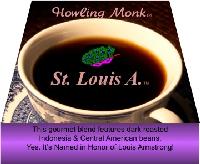
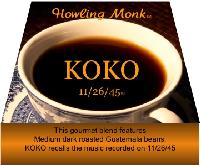
After you select a good book at Eso Won, select some HOWLING MONK COFFEE to go with it. MOOD NDIGO, MYSTERIOUSLY DARK ,and eL.A. available in one pound bags!
The Limbless Fox
There is the tale of a man who saw a limbless fox and wondered how it managed to be so well fed. Deciding to watch it, he found that it had positioned itself where a lion brought its kill. After eating, the lion would go away, and the fox would eat its leavings. So the man decided to allow fate to serve him in the same way.
Sitting down in a street and waiting, all that happened was that he became more and more weak and hungry, for nobody and nothing took an interest in him.
Eventually a voice spoke and said: “Why should you behave like a lamed fox? Why should you not be a lion, so that others might benefit from your leavings?”
We are the essence of a dual consciousness. One consciousness is an awareness of that which is outside ourselves, what is physical, the world around us and the outer spaces. The other is an awareness of that which is within us, what is spiritual, the soul, the mind and other such things. The condition of our dual consciousness is the state of our essential presence. It is that part of the mysterious entity of life that justifies life, establishes a balance that each individual must maintain. When our dual consciousness is balanced, we feel at ease. We have a sense of certainty and confidence. When it is not balanced, we feel uneasy, uncertain and confused.
All I Needed Was Time
The Mulla bought a donkey. Someone told him that he would have to give it a certain amount of food every day. This he considered to be too much. He would experiment, he decided, to get it used to less food. Each day, therefore, he reduced its rations.
Eventually, when the donkey was reduced to almost no food at all, it fell over and died.
“Pity,” said the Mulla. “If I had had a little more time before it died I could have got it accustomed to living on nothing at all.”
A Mulla Nasrudin Teaching Story from The Exploits of the Incomparable Mulla Naasrudin by Idries Shah
Why the free “Black” mind? People of African descent, particularly those in America - people often called "Black People" are the last large group of people to be enslaved. They were enslaved not by chains alone, but also by ideas designed to linger in the mind until they reconciled them in order to free themselves.
Sitting one day in the teahouse. Nasrudin was impressed by the rhetoric of a traveling scholar. Questioned by one of the company on some point, the sage drew a book from his pocket and banged it on the table: ‘This is my evidence! And I wrote it myself.’
A man who could not only read but write was a rarity. And a man who had written a book! The villagers treated the pedant with profound respect.
Some days later, Mulla Nasrudin appeared at the teahouse and asked whether anyone wanted to buy a house.
‘Tell us something about it, Mulla’ the people asked him, ‘for we did not even know you had a house of your own.’
‘Actions speak louder than words!’ shouted Nasrudin.
From his pocket he took a brick, and hurled it on the table in front of him.
‘This is my evidence. Examine it for quality. And I built the house myself.’
A Mulla Nasrudin Teaching Story from The Exploits of the Incomparable Mulla Naasrudin by Idries Shah
A farmer asked Nasrudin whether his olive would bear fruit in that year.
‘They will bear,” said the Mulla.
‘How do you know?’
‘I just know, that is all.’
Later the same man saw Nasrudin trotting his donkey along a seashore, looking for driftwood.
‘There is no wood here, Mulla, I have looked,’ he called out.
Hours later the same man saw Nasrudin wending his way home, tired out, still without fuel.
‘You are a man of perception, who can tell whether an olive tree will bear or not. Why can’t you tell whether there is wood on a seashore?’
'I know what must be,” said Nasrudin, ‘but I do not know what may be.’
A Mulla Nasrudin Teaching Story from The Pleasntries of the Incredible Mulla Naasrudin by Idries Shah
Black Surreality
The term “surrealist” was coined by Guillaume Apollinaire when it appeared in the preface to his play Les Mamelles de Tiresias (The Breasts of Tiresias), which was written in 1903 and first performed in 1917. Surrealism generally pertains to artwork, literature, and music, etc. characterized by their dreamlike and, sometimes, disorienting qualities. Surrealism is also the expression of a philosophical movement with the work as its artifact. An article on the history of surrealism describes it as a cultural movement that began in the 1920s to free the unconscious to express itself and help resolve contradictions between dreams and reality. Andre Breton, a leader of that movement, asserted that above all else, surrealism is revolutionary. The article goes on to say that Sigmund Freud's work with free association, dream analysis, and the unconscious was important to the Surrealists in developing methods that would liberate imagination.
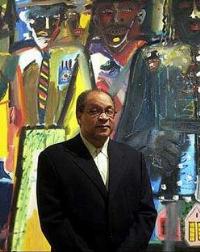
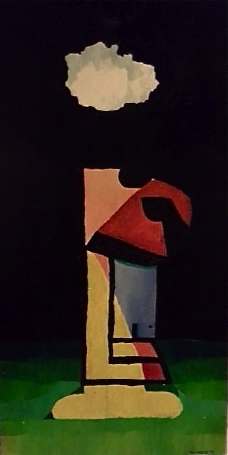
Hughie Lee-Smith
(September 20, 1915- February 23, 1999)
Hughie Lee-Smith lived through all but a decade and a half of the Twentieth Century. The African American Registry describes his paintings as expressing “a haunting sense of loneliness and alienation” of the American scene. “Mysteriously, they convey the feeling that something good is missing-and yet somehow about to happen...His vast skies, desolate scenes, and distanced people, his blowing ribbons and colorful balloons, mix realism and fantasy in surrealistic juxtapositions that reflect the contradiction and paradoxes of American life."
"I cannot begin to project the meaning of my work,” the artist said, “for these paintings, at their best, are multi-faceted visual complexes whose many aspects are pregnant with as many disparate meanings as there are viewers…I think my paintings have to do with an invisible life; a reality on a different level."
The Omen
The King was in a bad mood. As he left the palace to go hunting he saw Nasrudin.
“It is a bad omen to see a Mulla on the way to a hunt,” he shouted to his guards. “Don’t let him stare at me – whip him out of the way.”
They did so.
As it happened, the chase was successful.
The King sent for Nasrudin.
“I am sorry, Mulla. I thought you were a bad omen. You were not, it transpires.”
“You thought I was a bad omen!” said Nasrudin. “You look at me and get a full game bag. I look at you, and I get a whipping. Who is a bad omen for whom?”
A Mulla Nasrudin Teaching Story from The Exploits of the Incomparible Mulla Naasrudin by Idries Shah
Salt is not Wool
One day the Mulla was taking a donkey-load of salt to market and drove the ass through a stream. The salt was dissolved. The Mulla was angry at the loss of his load. The ass was frisky with relief.
Next time he passed that way he had a load of wool. After the animal had passed through the stream, the wool was thoroughly soaked, and very heavy. The donkey staggered under the soggy load.
‘Ha!’ shouted the Mulla, ‘you thought you would get off lightly every time you went through water, didn’t you?’
A Mulla Nasrudin Teaching Story from The Exploits of the Incomparable Mulla Naasrudin by Idries Shah
Forgetting
Forgetting is not a matter of choice or decision. Forgetting is a matter of time. Only the passage of time can completely dissolve a memory. And since the passage of time may be one that never-ends, wanting and trying to forget something may be a futile activity.
"You can’t make yourself love someone," she thought of him.
"You can’t make someone stop loving you," he often dreamt of her and she of him.
And so they drifted apart dreaming of love and one another.
Burnt Foot
An illiterate came to Nasrudin, and asked him to write a letter for him.
‘I can’t,’ said the Mulla, ‘because I have burned my foot.’
‘What has that got to do with writing a letter?’
‘Since nobody can read my handwriting, I am bound to have to travel somewhere to interpret the letter. And my foot is sore; so there is no point in writing the letter, is there?’
A Mulla Nasrudin Teaching Story from The Exploits of the Incomparable Mulla Naasrudin by Idries Shah
A Piece of Cake
Think of a delicious cake.
Now you have it. But can you have your cake and eat it too?
Think of life.
Now you have it. But you must live it.
Dance with Spirit!
Peace
Welcome!
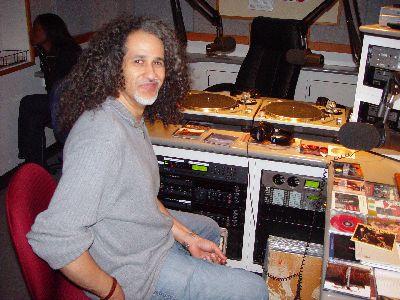
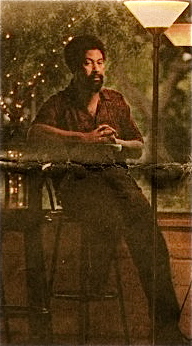
My name is Kenneth Moore. The Howling Monk website is dedicated to Baby Boomers and cool people of all generations. You're invited to explore A Jazz State of Mind, read and comment, peruse the artwork, watch the videos, and listen to the music, etc.
Howling Monk was founded in Inglewood California in 1998 as a continuation of the family business tradition started by my Grandfather in Chicago Illinois. The name, Howling Monk, is a tribute to the legendary bluesman, Howling Wolf, and to Thelonious Monk, a true genius of the music called Jazz.


.jpeg)
.jpg)



.jpg)
.jpg)
.jpg)
.jpg)
.jpg)
.jpg)
.jpg)
.jpg)







.jpeg)